
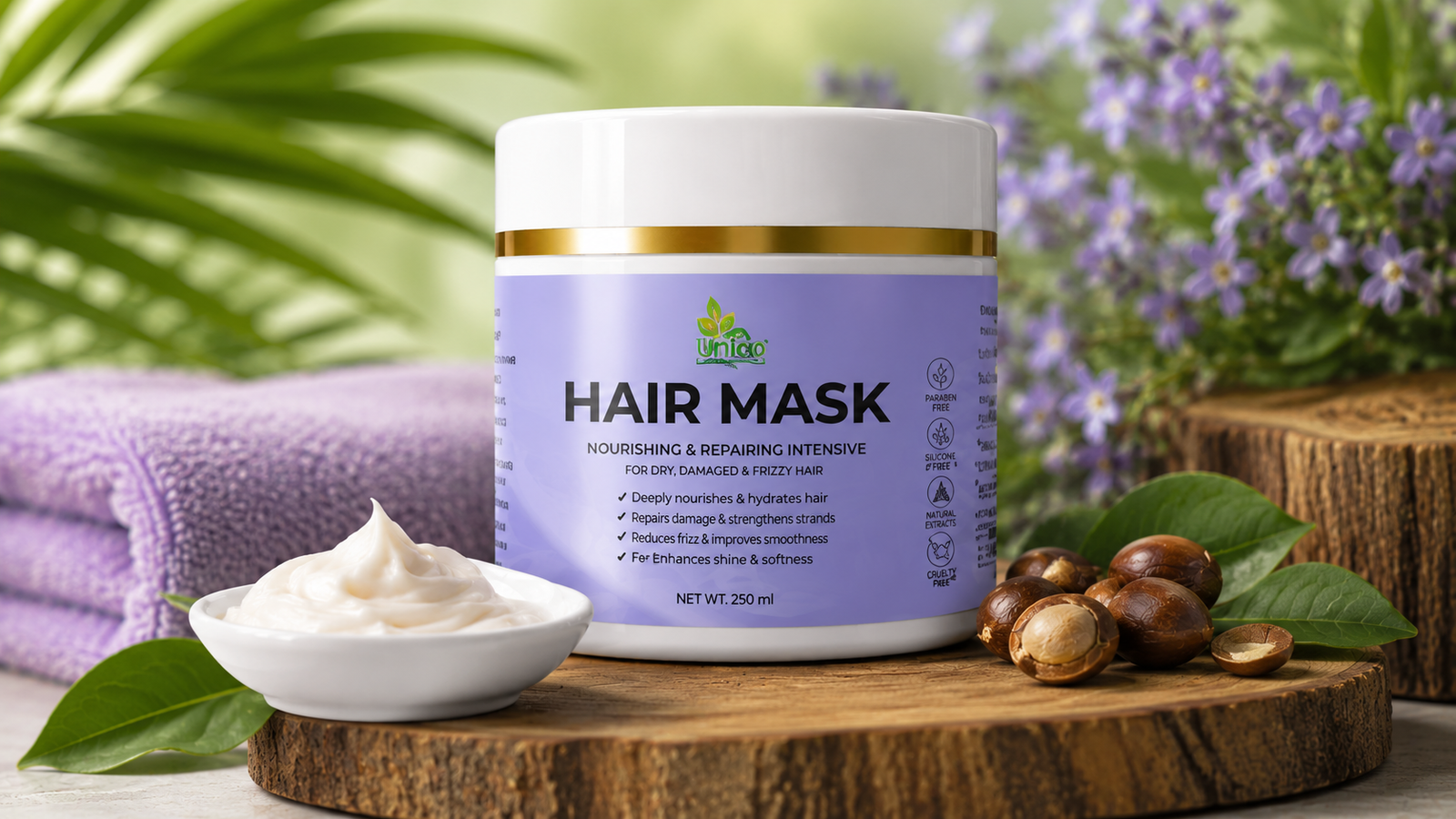
Introduction: Why Hair Masks Matter in a Hair Care Routine
Hair is exposed to many factors every day. Washing, heat styling, sunlight, pollution, colouring, chemical treatments, brushing and environmental changes can all affect the way hair looks and feels. Over time, hair may start to feel rough, dry, tangled or less manageable. This is where a well-formulated hair mask can become a useful addition to a regular hair care routine.
Unlike a regular conditioner that is generally designed for quick everyday conditioning, a hair mask is commonly used as a more intensive conditioning treatment. Depending on the formulation, a hair mask may contain conditioning agents, oils, butters, proteins, botanical extracts, vitamins and other ingredients selected to improve the feel, softness, smoothness and manageability of the hair.
However, simply applying a hair mask is not enough. The way you use it also matters. Applying too much product, putting a rich mask directly on the scalp when it is not designed for scalp use, leaving it on for longer than recommended or using it too frequently may not provide the experience you expect.
Quick answer: For most rinse-off hair masks, the general routine is to shampoo first, remove excess water, apply the mask mainly to the mid-lengths and ends, leave it on according to the product instructions and rinse thoroughly. Always follow the directions of the specific formulation.
What Is a Hair Mask?
A hair mask is a concentrated conditioning treatment designed to give the hair additional care beyond a basic cleansing routine. It is usually applied to the hair lengths and ends and kept on for a specific period before rinsing.
Hair masks can be developed for different consumer requirements. Some formulations focus on dry hair and intensive conditioning, while others may be designed for frizz control, smoothness, colour-treated hair, curly hair or general nourishment.
The ideal hair mask depends on the hair type, formulation, ingredient combination and intended cosmetic benefit. A lightweight formula may be more comfortable for fine hair, while a richer conditioning formula may be preferred by consumers with thick, dry or highly textured hair.
Common Hair Concerns for Which Hair Masks Are Used
- Dry or rough hair
- Frizzy and difficult-to-manage hair
- Dull-looking hair
- Hair that feels dry after styling
- Hair affected by frequent heat styling
- Colour-treated or chemically treated hair
- Curly or wavy hair that needs additional conditioning
- Hair that becomes tangled easily
- Dry-looking lengths and ends
Benefits of Using a Hair Mask
A properly formulated hair mask can provide a richer conditioning experience than a standard daily conditioner. The exact results depend on the ingredients, formulation and individual hair condition.
1. Helps Improve Hair Softness
Dry hair can feel rough when touched. Conditioning ingredients can improve the surface feel of the hair and make it feel softer and more comfortable to handle.
2. Helps Improve Manageability
Hair that becomes tangled easily can be difficult to comb and style. A conditioning treatment can help make the hair feel smoother and easier to manage after washing.
3. Helps Reduce the Appearance of Frizz
Frizz can become more noticeable when hair is dry, rough or exposed to humidity. A suitable conditioning mask can help improve smoothness and reduce the appearance of uncontrolled flyaways.
4. Supports a Shiny Appearance
Smooth-looking hair can reflect light more evenly, which may make it appear shinier. Conditioning the hair surface can therefore contribute to a healthier-looking finish.
5. Provides Additional Conditioning
Hair masks are particularly useful when regular conditioning does not feel sufficient for the lengths and ends. They can be included as an additional treatment once or twice a week depending on the product instructions and hair needs.
How to Use a Hair Mask Correctly: Step-by-Step Guide
Correct application is one of the most important parts of getting the best experience from a hair mask. The following routine is suitable as a general guide for many rinse-off hair masks, although the instructions printed on the individual product should always take priority.
Wash Your Hair
Start by washing the hair with a suitable shampoo. This helps remove dirt, sweat, excess oil and styling product buildup before the conditioning treatment.
Remove Excess Water
Gently squeeze or towel-blot excess water. Hair should generally be damp rather than dripping wet unless the product specifically recommends another method.
Apply the Mask
Take a suitable amount and distribute it through the mid-lengths and ends. Use enough product to coat the hair without applying unnecessarily large amounts.
Leave It On
Allow the mask to remain on the hair for the time recommended on the product label. Many rinse-off masks are used for around 10–20 minutes.
Rinse Thoroughly
Rinse the hair thoroughly with clean water until the product has been removed and the hair feels clean, conditioned and comfortable.
Use Consistently
Follow the recommended frequency. For many formulas, once or twice weekly may be suitable, but this varies according to formulation and hair type.
When Should You Use a Hair Mask?
There is no single schedule that works for everyone. Hair texture, dryness, styling habits, product formulation and personal preference all influence how frequently a hair mask should be used.
People with very dry or coarse hair may prefer a richer conditioning routine, while people with fine or oily hair may prefer a lightweight formula and less frequent use.
As a general starting point, many rinse-off hair masks can be used around once or twice per week. However, always follow the usage instructions provided with the particular product.
How to Use a Hair Mask According to Your Hair Type
For Dry Hair
Dry hair generally benefits from additional conditioning. Apply the mask mainly to the lengths and ends and allow it to remain on the hair for the recommended time. Look for a formulation designed around moisturising and conditioning needs.
For Frizzy Hair
Frizzy hair can benefit from products designed to improve smoothness and manageability. A conditioning mask may help hair feel softer and easier to style. Avoid using more product than necessary because excessive product can make hair feel heavy.
For Curly or Wavy Hair
Curly and wavy hair can sometimes feel dry because natural oils may not distribute evenly along the hair length. A suitable conditioning mask can be incorporated into a routine designed to maintain softness and manageability without unnecessarily weighing down the curls.
For Fine Hair
Fine hair may become weighed down more easily. Choose a lighter formulation when appropriate and focus the product on the mid-lengths and ends rather than applying a large quantity near the roots.
For Thick or Coarse Hair
Thick or coarse hair may benefit from a richer conditioning treatment. Work the product through the lengths and ends so that the hair is evenly coated.
For Colour-Treated Hair
Colour-treated hair can benefit from a carefully selected conditioning routine. When choosing a mask, consider whether the formulation is suitable for colour-treated hair and follow the recommended usage instructions.
Ingredients Commonly Used in Hair Mask Formulations
Different hair masks use different combinations of conditioning, nourishing and functional ingredients. The formulation should be developed according to the intended product benefits, texture, consumer expectations and target hair type.
Argan Oil
Commonly used in hair care formulations designed to provide conditioning and improve the feel and appearance of dry hair.
Coconut Oil
A widely used hair care ingredient that can contribute to nourishing and conditioning formulations.
Shea Butter
Often included in richer conditioning formulas where a creamy texture and intensive conditioning experience are desired.
Aloe Vera
A popular botanical ingredient used in various personal care and hair care formulations.
Avocado Oil
Used in some nourishing hair care formulations to support a smooth and conditioned hair feel.
Jojoba Oil
Commonly used in cosmetic formulations where a lightweight conditioning profile is desired.
Vitamin E
Frequently used in cosmetic and personal care formulations as part of carefully designed product systems.
Proteins & Conditioning Agents
Selected proteins and conditioning ingredients may be used to improve the feel, smoothness and manageability of hair.
Hair Mask vs Conditioner: What Is the Difference?
Hair masks and conditioners are both designed to condition the hair, but they are generally positioned differently within a hair care routine. Conditioner is often used after shampooing as part of regular washing, while a hair mask is commonly used as a more intensive treatment.
| Feature | Conditioner | Hair Mask |
|---|---|---|
| Primary purpose | Regular conditioning | More intensive conditioning |
| Typical frequency | Often used regularly | Often used once or twice weekly |
| Application time | Usually shorter | Usually longer |
| Texture | Often lighter | Can be richer or creamier |
| Best suited for | Everyday conditioning | Additional intensive hair care |
Common Hair Mask Mistakes to Avoid
1. Applying Too Much Product
More product does not automatically mean better results. Applying excessive quantities can make the hair feel heavy or difficult to rinse. Use an amount appropriate for your hair length and thickness.
2. Applying a Regular Hair Mask Directly to the Scalp
Not every hair mask is formulated for scalp application. Unless the product specifically says it is suitable for the scalp, concentrate the mask on the hair lengths and ends.
3. Leaving the Mask on Too Long
Follow the product instructions rather than assuming that a longer application time will provide better results. Different formulations are developed for different application periods.
4. Using It Too Frequently
The ideal frequency depends on the formulation and hair type. Start with the recommended schedule and adjust only according to your hair's response and the product instructions.
5. Rinsing Too Quickly
If the product recommends a specific application time, allow it to remain on the hair for that duration before rinsing.
6. Ignoring Your Hair Type
A rich mask may feel excellent on thick, dry hair but may feel too heavy on fine hair. Choosing the right formulation is therefore just as important as the application method.
How to Build a Simple Hair Mask Routine
A hair mask works best when it is part of a broader hair care routine. You do not necessarily need a complicated routine to maintain healthy-looking hair.
- Choose a shampoo suitable for your hair type.
- Wash the hair gently without unnecessary friction.
- Remove excess water before applying a rinse-off mask.
- Apply the mask mainly to lengths and ends.
- Follow the recommended application time.
- Rinse thoroughly after the treatment.
- Limit excessive heat styling whenever possible.
- Use gentle combing and avoid unnecessary pulling.
- Trim visibly split ends when required.
- Maintain consistency rather than overusing products.
Hair Mask Manufacturing Solutions for Growing Brands
For businesses planning to launch their own hair care products, choosing the right manufacturing partner is an important part of product development. Unico Pharmaceuticals brings more than 35 years of industry experience and provides manufacturing support for cosmetic, hair care and personal care products.
Unico supports businesses with product development, formulation, manufacturing, quality checks, filling, packaging and labelling according to project requirements. The company also provides private label and third-party manufacturing solutions for businesses looking to develop products under their own brand name.
If you are planning a hair mask product for dry hair, frizzy hair, intensive conditioning, smoothness, nourishment or another positioning, the formulation and product specifications can be discussed according to your target market and brand requirements.
Unico's manufacturing approach combines experienced professionals, modern infrastructure and quality-focused production processes. The company also maintains an in-house laboratory and quality control support for its manufacturing operations.
Why Choose Unico Pharmaceuticals for Hair Mask Manufacturing?
Developing a hair mask brand involves more than simply selecting a product name. Businesses need to consider formulation, product texture, ingredient selection, packaging, labelling, quality requirements and production quantities.
Unico Pharmaceuticals provides manufacturing support designed to make this process more organised for businesses, startups, distributors and established brands.
- 35+ years of industry experience in manufacturing.
- GMP certificated manufacturing support.
- Product formulation and development assistance.
- Private label hair care manufacturing.
- Third-party manufacturing support.
- Quality checks and controlled production processes.
- Filling and packaging support.
- Labelling and finished product preparation.
- Hair care product category support.
- Business-focused manufacturing coordination.
You can also explore the Private Label Hair Care Manufacturing page to understand the broader manufacturing support available for hair care brands.
Quality and Manufacturing Standards
Quality is an important part of any cosmetic and hair care product. Product consistency depends on controlled raw material handling, formulation, manufacturing, testing, filling and packaging processes.
Unico Pharmaceuticals highlights GMP, ISO and HACCP quality and safety standards as part of its manufacturing approach. Businesses interested in understanding the available certifications can visit the Unico Certificates page.
For a brand owner, working with a structured manufacturing partner can make it easier to coordinate product requirements from the initial concept through the finished product.
How to Start Your Own Hair Mask Brand with Unico
If you are planning to introduce a private label or third-party hair mask product, the process can begin with a clear product requirement. This may include the target hair type, desired texture, product size, packaging format and intended positioning.
Step 1: Share Your Product Requirement
Share your product idea, expected quantity, packaging preference and target market with the manufacturing team.
Step 2: Discuss Formulation
The formulation can be discussed according to the intended product concept, desired cosmetic benefits and market positioning.
Step 3: Product Development and Sampling
Depending on the project, product samples can be developed for review and approval before moving toward bulk production.
Step 4: Manufacturing and Quality Checks
After approval, the product can move into manufacturing with quality checks carried out according to the applicable product requirements.
Step 5: Packaging and Labelling
Packaging and labelling requirements can be coordinated according to the brand's product specifications.
Step 6: Final Product and Dispatch
Once the final quality and packaging requirements are completed, finished products are prepared for dispatch.
Explore More from Unico Pharmaceuticals
If you are researching hair care and cosmetic manufacturing, the following pages can help you explore Unico's product categories and manufacturing capabilities:
- Hair Care Products & Manufacturing – Explore hair care products and the manufacturing process.
- Best Hair Mask for Dry Hair – Read more about hair masks, benefits and hair care tips.
- Private Label Hair Care Manufacturer – Explore private label hair care manufacturing solutions.
- Cosmetic Manufacturing – Explore Unico's broader cosmetic manufacturing capabilities.
- About Unico Pharmaceuticals – Learn about Unico's experience, infrastructure and manufacturing approach.
- GMP, ISO & HACCP Certificates – View available quality and certification information.
Conclusion
Knowing how to use a hair mask correctly can make a meaningful difference to your hair care routine. A good hair mask can provide additional conditioning and help hair feel softer, smoother and easier to manage.
The basic method is simple: wash your hair, remove excess water, apply an appropriate amount of mask mainly to the lengths and ends, leave it on for the recommended period and rinse thoroughly. Depending on the formulation and your hair type, using a hair mask once or twice a week may be suitable.
Choosing the right product is equally important. Dry, curly, thick, fine, frizzy and colour-treated hair may all have different conditioning requirements. Ingredients such as argan oil, coconut oil, shea butter, aloe vera, avocado oil, jojoba oil, vitamin E, proteins and conditioning agents may be incorporated into formulations depending on the intended product benefits.
For businesses, hair masks also represent an opportunity to develop specialised hair care products for different consumer needs. Unico Pharmaceuticals supports businesses with hair care manufacturing, private label and third-party manufacturing solutions backed by 35+ years of industry experience.
Whether you are looking for a conditioning hair mask for your own product line or planning a complete hair care range, a structured approach to formulation, manufacturing, packaging and quality can help create a professional market-ready product.
Looking for a Hair Mask Manufacturing Partner?
Discuss your hair mask, private label or third-party manufacturing requirements with Unico Pharmaceuticals. From formulation and manufacturing to packaging and labelling, our team can help you plan your product requirements.
Contact Unico PharmaceuticalsFrequently Asked Questions About Hair Masks
Click any question below to view the answer.
1. How often should I use a hair mask?
Many rinse-off hair masks can be used once or twice a week, but the ideal frequency depends on your hair type and the specific formulation. Always follow the usage instructions provided on the product.
2. Should I apply a hair mask before or after shampoo?
Most rinse-off hair masks are applied after shampooing on clean, damp hair. However, some products may have different directions, so always follow the manufacturer's instructions.
3. How long should I leave a hair mask on my hair?
Many rinse-off hair masks are used for approximately 10–20 minutes, but the correct time depends on the formulation. Follow the application instructions on the specific product.
4. Can I apply a hair mask directly to my scalp?
Not every hair mask is designed for scalp application. Unless the product specifically states that it is suitable for the scalp, apply the mask mainly to the mid-lengths and ends of the hair.
5. Can a hair mask make hair soft and shiny?
A well-formulated conditioning mask can help improve the feel, smoothness and manageability of the hair. Smoother hair can also appear shinier because it can reflect light more evenly.
6. Can a hair mask repair damaged hair?
A cosmetic hair mask cannot permanently reverse structural hair damage. However, it can improve the appearance and feel of damaged-looking hair by providing conditioning, softness, smoothness and better manageability.
7. What is the difference between a hair mask and conditioner?
Conditioner is generally used as part of regular hair washing, while a hair mask is commonly used as a more intensive conditioning treatment. Hair masks are often left on the hair for a longer period than regular conditioners.
8. Is a hair mask suitable for curly hair?
Yes. Hair masks can be formulated for curly and wavy hair. Curly hair may benefit from additional conditioning, but the ideal product depends on the curl pattern, thickness, dryness and individual hair requirements.
9. Can fine hair use a hair mask?
Yes. Fine hair can use a hair mask, but a lightweight formulation and a suitable quantity may be preferable. Applying excessive amounts can make fine hair feel heavy.
10. Can I leave a regular hair mask overnight?
A regular rinse-off hair mask should generally be used according to its recommended application time. Only leave a product overnight if it has specifically been formulated and labelled for overnight use.
11. Can a hair mask help with split ends?
A hair mask can condition dry-looking ends and improve their appearance and feel, but it cannot permanently repair an existing split hair strand. Trimming is the appropriate way to remove split ends.
12. What ingredients are commonly used in hair masks?
Depending on the formulation, hair masks may contain ingredients such as argan oil, coconut oil, shea butter, aloe vera, avocado oil, jojoba oil, vitamin E, proteins and different conditioning agents.
13. What is a private label hair mask?
A private label hair mask is manufactured for a business and sold under that business's own brand name. Depending on the project, manufacturing support can include formulation, product development, packaging and labelling.
14. Does Unico Pharmaceuticals manufacture hair masks?
Yes. Unico Pharmaceuticals provides hair care manufacturing support and can work with businesses on hair mask product requirements, including private label and third-party manufacturing solutions.
15. Can Unico provide private label hair care manufacturing?
Yes. Unico Pharmaceuticals supports private label hair care manufacturing for businesses looking to develop products under their own brand. Formulation, manufacturing, packaging and labelling requirements can be discussed according to the project.
16. How can I contact Unico Pharmaceuticals for hair mask manufacturing?
You can contact Unico Pharmaceuticals through the Contact Us page and share your product requirements, expected quantity, packaging preferences and other relevant details.