
Natural Body Wash Manufacturing in India: Business Opportunities for Skincare Brands
The demand for personal care products has created opportunities for skincare businesses looking to introduce their own branded body wash ranges. From aloe vera body wash and herbal-inspired cleansing products to refreshing formulations with botanical ingredients, body wash is a product category that can complement many cosmetic and personal care collections. For entrepreneurs, retailers, distributors and established skincare companies, working with a natural body wash manufacturer can provide a way to explore product development without setting up an entire manufacturing facility. Through private label body wash manufacturing, businesses can discuss formulation preferences, ingredients, packaging and branding with an experienced manufacturing partner. This guide explains natural body wash manufacturing in India, business opportunities for skincare brands, bulk production considerations and the important steps involved in developing a branded body wash product.
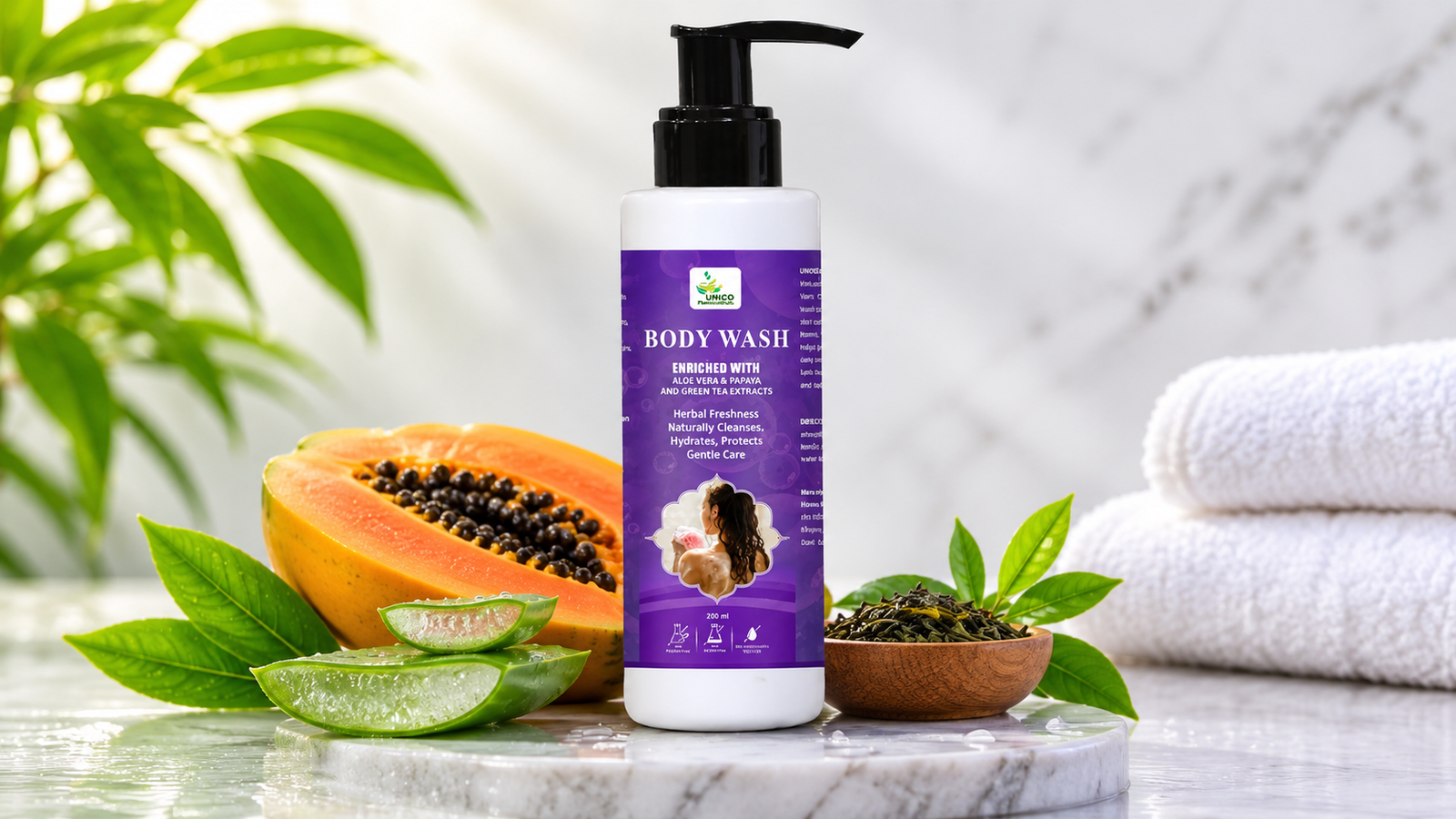
Natural-inspired body wash product presentation featuring Aloe Vera, Papaya and Green Tea extracts for personal care and skincare brands.
Body wash is used in everyday personal care routines and can be developed in different product styles to match customer preferences. A brand may want a gentle daily cleansing product, a refreshing botanical-inspired body wash or a coordinated range of personal care products. Each concept requires planning around formulation, product positioning, packaging and manufacturing requirements.
For businesses exploring body wash manufacturing in India, the first step is to understand the product category and identify the type of manufacturing support required. This includes evaluating existing product options, discussing customisation possibilities, selecting packaging and understanding the commercial terms before placing a bulk order.
Quick Answer: Natural body wash manufacturing involves product planning, formulation selection, ingredient evaluation, sample review, packaging, branding, production and quality checks. Businesses can approach a private label body wash manufacturer to discuss their product concept and explore suitable manufacturing options. The final formulation, customisation, MOQ, pricing and production schedule should be confirmed directly with the manufacturer.
1. Understanding Natural Body Wash Manufacturing
Natural body wash manufacturing is the process of developing and producing liquid cleansing products for personal care brands. The process may involve selecting an existing formulation, discussing ingredient preferences, evaluating product texture, choosing a fragrance direction and deciding on suitable packaging. The exact manufacturing process depends on the product specifications and the capabilities of the manufacturing facility.
For a skincare business, manufacturing is not limited to filling a bottle with a cleansing liquid. The product must be planned as part of a brand's overall product range. Its formulation, appearance, fragrance, packaging and product information should work together to create a consistent presentation.
What makes a body wash product natural-inspired?
Many brands explore plant-inspired ingredients when developing personal care products. Aloe vera, papaya and green tea are examples of botanical ingredients that may be considered in body wash product concepts. Their suitability, grade, concentration and role in the final formulation should be discussed with the manufacturer.
The word natural should also be used responsibly. A product should not automatically be described as completely natural, organic or chemical-free simply because it contains botanical extracts. The actual ingredient composition and supporting product documentation should determine the claims used on the packaging and in marketing.
Why manufacturing planning matters
A clearly planned product brief helps the manufacturer understand the requirements before development begins. Businesses should identify the intended customer, preferred product type, approximate order quantity, packaging expectations and branding preferences. This makes it easier to discuss product feasibility and obtain a relevant quotation.
2. Business Opportunities in the Body Wash Market
Body wash offers opportunities for businesses operating in cosmetics, skincare, personal care retail and distribution. Since it is a familiar daily-use category, it can complement existing product collections and give new brands another category to explore.
For entrepreneurs planning a skincare business, introducing a body wash product can be one part of a broader product strategy. Existing businesses may also consider adding body wash to their current ranges to offer customers more personal care choices.
Opportunities for different business types
- Skincare startups: Develop a branded body wash as part of a new personal care range.
- Cosmetic brands: Expand an existing skincare collection with body cleansing products.
- Retail businesses: Explore private label products under their own store or business brand.
- Distributors: Discuss branded product ranges suitable for their distribution networks.
- Beauty and wellness businesses: Consider body wash as a complementary personal care category.
- Established personal care companies: Explore additional product variants for an existing customer base.
- Entrepreneurs: Evaluate manufacturing partnerships before investing in their own production infrastructure.
Developing a focused product range
Instead of launching many products at once, businesses can begin by identifying a clear product concept. For example, a brand focused on botanical-inspired skincare may explore an aloe vera and green tea body wash. Another brand may prefer a refreshing daily-use cleansing product with a different fragrance and packaging direction.
The product concept should be based on the intended customer and the brand's positioning. A clear strategy can help businesses plan their product presentation, pricing, packaging and future product extensions.
3. What Is Private Label Body Wash Manufacturing?
Private label body wash manufacturing allows a business to sell a body wash product under its own brand name while working with a third-party manufacturer for production. Depending on the manufacturer's services, the project may involve selecting a suitable existing formulation, discussing product modifications, choosing packaging and arranging branded labels or artwork.
This model can be useful for startups and established businesses that want to develop a personal care product range without independently establishing every part of the manufacturing setup.
How private label manufacturing works
A business shares its product requirements with a manufacturer. The manufacturer discusses the available product options, formulation requirements, packaging possibilities and commercial terms. Where applicable, samples may be reviewed before the product specifications are finalised.
Once the relevant details are approved, the order can move forward according to the agreed production arrangement. The finished product is supplied in the approved packaging and branding format, subject to the services agreed for the project.
Private label versus standard branded products
A standard branded product is generally sold under the manufacturer's or another established brand's identity. In a private label arrangement, the business discusses selling the product under its own brand identity. The level of customisation varies and may depend on the formulation, packaging availability and minimum order quantity.
| Area | Private Label Manufacturing | What the Business Should Confirm |
|---|---|---|
| Branding | Product may carry the buyer's brand identity. | Logo, label and artwork requirements. |
| Formulation | Existing or discussed formulation options. | Available ingredients and customisation scope. |
| Packaging | Selected packaging can be discussed. | Container availability and printing options. |
| Production | Manufacturing is handled by the partner. | Production capacity and order terms. |
| Quantity | Subject to the manufacturer's MOQ. | Minimum order per product and variant. |
Why businesses consider private label body wash
Private label manufacturing can simplify the process of exploring a new product category. Businesses can focus on their brand identity, customer research, distribution and marketing while discussing production with a suitable manufacturing partner. However, it is important to evaluate the manufacturer's capabilities and commercial terms before making a commitment.
4. Understanding Natural Body Wash Ingredients
Ingredients play an important role in body wash formulation. They influence cleansing performance, texture, appearance, fragrance and the overall product experience. Businesses exploring natural body wash manufacturing should understand the ingredient categories involved and discuss their preferences with the manufacturer.
1. Aloe Vera
Aloe vera is a widely recognised botanical ingredient used in different personal care product concepts. It may be considered when developing a body wash with a botanical-inspired identity. Brands should discuss the specific aloe vera ingredient, its quality specifications and its suitability within the complete formulation.
2. Papaya Extract
Papaya extract is another botanical ingredient that can be included in selected cosmetic and personal care formulations. It may be considered for a fruit-inspired product concept. The actual function and suitability of the extract depend on its specifications, formulation compatibility and intended use.
3. Green Tea Extract
Green tea extract is used in various cosmetic product concepts and may be considered when developing a botanical-inspired body wash. Businesses should discuss the ingredient grade, formulation compatibility and relevant documentation with the manufacturer.
4. Cleansing Ingredients
Cleansing ingredients are central to the development of a body wash. Their selection influences the product's cleansing characteristics, foam, texture and application experience. The manufacturer should evaluate the combination of ingredients according to the intended product specifications.
5. Moisturising and Conditioning Ingredients
Selected moisturising and conditioning ingredients may be considered to influence the after-wash skin feel. Their choice depends on the overall formulation, desired product experience and compatibility with other ingredients.
6. Fragrance Components
Fragrance is an important part of the sensory experience of many body wash products. Brands may explore fresh, floral, fruity or herbal fragrance directions. The final selection should be appropriate for the intended cosmetic application and evaluated within the complete formulation.
| Ingredient Category | Role in Product Development | What Brands Should Discuss |
|---|---|---|
| Aloe Vera | Botanical ingredient for a plant-inspired product concept. | Ingredient grade and formulation suitability. |
| Papaya Extract | Fruit-inspired botanical ingredient. | Specifications and compatibility. |
| Green Tea Extract | Botanical ingredient for personal care formulations. | Quality and intended formulation role. |
| Cleansing Ingredients | Contribute to cleansing and foaming characteristics. | Desired cleansing experience and formulation. |
| Conditioning Ingredients | Influence the product's after-wash feel. | Texture and skin-feel preferences. |
| Fragrance | Provides the selected fragrance profile. | Suitable fragrance options and compatibility. |
The Aish body wash product shown in this article features Aloe Vera, Papaya and Green Tea Extracts as part of its product presentation. These ingredients provide a useful example of how a brand can communicate a botanical-inspired body wash concept.
Businesses should remember that the presence of a botanical ingredient does not automatically establish a particular clinical benefit. All product claims should reflect the actual formulation and available supporting evidence.
5. Body Wash Formulation and Product Development
Body wash formulation is one of the most important stages of product development. The formulation determines the product's consistency, cleansing characteristics, foam, fragrance and overall application experience. A suitable formulation should also work with the selected packaging and intended product positioning.
Texture and consistency
Body wash products may have different viscosities depending on the formulation concept. Some brands prefer a smooth, flowing liquid, while others may want a thicker gel-like consistency. The desired texture should be communicated before samples are evaluated.
Foaming characteristics
Foam is one of the characteristics customers may notice when using body wash. The cleansing system and formulation influence the product's foaming behaviour. Businesses should discuss the desired experience with the manufacturer instead of assuming that all body wash formulations behave in the same way.
Fragrance and appearance
The fragrance and appearance should be consistent with the brand's identity. A botanical-inspired product may use a fragrance direction that complements its ingredient story, while a refreshing daily-use product may require a different presentation. Colour, fragrance and consistency should be reviewed together during sample evaluation.
Packaging compatibility
The selected formulation should be suitable for the intended bottle and dispensing system. Product consistency, closure design, pump compatibility and container material should be considered during development.
Important: Do not finalise a body wash product only by looking at its colour, fragrance or ingredient list. Evaluate the complete formulation, packaging compatibility, product specifications and quality documentation before approving bulk production.
6. Different Types of Body Wash Products
Body wash manufacturers may work with different product concepts depending on their capabilities and the requirements of the business. Selecting a product type helps define the formulation discussion, ingredient preferences and packaging direction.
Aloe Vera Body Wash
An aloe vera body wash is a botanical-inspired product concept for brands interested in aloe vera as part of their personal care range. Businesses should discuss the ingredient specifications, formulation and suitable product presentation.
Herbal Body Wash
Herbal body wash products are developed around selected botanical-inspired ingredients and product positioning. Brands should ensure that the formulation and ingredient descriptions accurately reflect the finished product.
Green Tea Body Wash
Green tea-inspired body wash can be considered by businesses looking to introduce a botanical-focused cleansing product. Ingredient selection, fragrance and packaging can be discussed according to the brand's requirements.
Refreshing Daily-Use Body Wash
A refreshing body wash is a broad product concept that can be developed for everyday personal care routines. Fragrance, cleansing characteristics and texture are important considerations when finalising this type of product.
Moisturising Body Wash
Brands interested in a moisturising product concept can discuss suitable conditioning ingredients and the desired after-wash feel. The finished formulation should be evaluated rather than relying only on ingredient descriptions.
Premium Body Wash
Premium-inspired body wash products may focus on distinctive packaging, coordinated branding, selected fragrances and a carefully developed product presentation. The overall product experience should match the brand's intended positioning.
The right body wash type depends on the target customer, product range, brand identity and manufacturing requirements. Businesses should finalise the product concept before moving into detailed packaging and artwork discussions.
7. The Body Wash Manufacturing Process
Commercial body wash manufacturing involves several stages, from initial product planning to final packaging and dispatch. The exact production method depends on the formulation, manufacturing equipment and quality procedures followed by the facility.
Step 1: Product Concept and Requirement Planning
Start by deciding the type of body wash you want to develop. Define your target audience, preferred ingredients, fragrance direction, texture, product size and brand positioning. If you have a reference product or design, share it with the manufacturer.
Step 2: Formulation Discussion
Discuss the proposed formulation and ingredient preferences. Ask the manufacturer which options are available and whether the project can use an existing formulation or requires additional development discussions.
Step 3: Sample Development and Evaluation
Where available, request a sample to evaluate its consistency, fragrance, appearance, foam and overall application experience. Share specific feedback and clarify which characteristics need to be adjusted before final approval.
Step 4: Packaging Selection
Choose the bottle, closure, pump or flip-top format according to the product and brand requirements. Confirm packaging availability, material, dimensions and compatibility with the selected formulation.
Step 5: Label and Artwork Approval
Prepare the brand logo, product name, colour scheme and label artwork. Check spelling, readability, ingredient information and applicable declarations. Review the final artwork before printing.
Step 6: Bulk Manufacturing
After the relevant product and packaging specifications have been approved, the order can proceed according to the agreed production plan. Confirm the order quantity, production schedule and applicable commercial terms.
Step 7: Filling and Packaging
The finished formulation is filled into the selected containers according to the production arrangement. Packaging and batch-related details should be checked against the approved specifications.
Step 8: Quality Checks and Dispatch
Finished products should undergo the applicable quality checks before release. Confirm the product documentation, packing details and dispatch arrangements with the manufacturer.
Manufacturing tip: Keep written records of the approved formulation, packaging format, label artwork, product size and order quantity. These details help maintain clarity between the business and manufacturing partner throughout the project.
8. Body Wash Packaging and Branding Ideas
Body wash packaging plays an important role in product presentation. The bottle design, colour scheme, label layout and dispensing system contribute to how customers recognise and use the product. For a private label body wash brand, packaging should be planned alongside formulation development.
Minimal and Clean Packaging
Minimal packaging uses simple colours, clear typography and a neat label layout. This approach can suit brands that want an understated personal care identity. It also helps maintain a consistent visual style across multiple products.
Botanical-Inspired Packaging
Aloe vera, papaya and green tea-inspired designs may use botanical colours, ingredient illustrations and nature-inspired visual elements. The packaging should communicate the product concept without making unsupported ingredient or performance claims.
Premium Body Wash Packaging
Premium-inspired packaging may include distinctive bottle shapes, coordinated label finishes and carefully selected colours. Brands should balance visual presentation with practical usability and packaging costs.
Transparent and Coloured Bottles
Transparent, translucent and opaque containers offer different visual possibilities. The choice depends on the product's appearance, packaging material, compatibility and the brand's preferred design.
Pump and Flip-Top Packaging
Pump bottles can offer convenient dispensing for certain body wash formats, while flip-top bottles provide another practical option. The final choice should consider bottle size, dispensing requirements, closure quality and product consistency.
| Packaging Format | Key Characteristics | What to Confirm |
|---|---|---|
| Pump Bottles | Convenient dispensing format. | Pump compatibility and bottle capacity. |
| Flip-Top Bottles | Practical opening and closing system. | Closure fit and dispensing performance. |
| Transparent Bottles | Showcase the product's appearance. | Material and product compatibility. |
| Opaque Bottles | Provide a different visual presentation. | Colour, finish and label design. |
| Custom Packaging | Distinctive brand-focused presentation. | Availability, cost and minimum quantity. |
Before finalising packaging, request available samples or specifications. Check the container material, dimensions, closure, dispensing mechanism and label area. A visually attractive bottle should also be suitable for the product and intended usage.
9. Custom Body Wash Manufacturing for Your Brand
Custom body wash manufacturing allows businesses to discuss product requirements according to their brand concept. Depending on the manufacturer's capabilities, customisation may involve ingredient preferences, fragrance direction, texture, packaging, label design and product presentation.
Custom Formulation Requirements
Some businesses may want an existing body wash formulation, while others may have specific ingredient or product characteristics in mind. Discuss the requirements with the manufacturer and confirm which modifications are technically and commercially feasible.
Custom Fragrance and Product Appearance
Fragrance and appearance can help distinguish one product range from another. Brands may explore suitable fragrance options, product colours and consistency according to their intended positioning. Any changes should be evaluated through the available sample and approval process.
Custom Labels and Branding
Private label body wash products can be presented using the buyer's brand identity, subject to the agreed manufacturing and packaging services. Businesses should prepare their logo, product name, artwork and required product declarations before final printing.
Building a Consistent Product Collection
If you plan to launch multiple personal care products, maintain consistency in logo placement, typography, colours and packaging style. A coordinated range can help customers recognise products belonging to the same brand.
For example, a brand may plan a body wash alongside a face wash, shampoo or body lotion. Each product should have its own appropriate formulation and packaging, while the overall visual identity remains consistent.
10. Bulk Body Wash Manufacturing and MOQ
Bulk body wash manufacturing is relevant for businesses that need larger production quantities for retail, distribution or their own product range. Working with a bulk body wash manufacturer requires clarity about the order size, product variants, packaging requirements and production schedule.
What is MOQ?
MOQ stands for Minimum Order Quantity. It is the minimum quantity a manufacturer accepts for a particular product or manufacturing arrangement. MOQ can vary according to the formulation, packaging type, customisation level and production requirements.
Why MOQ matters for new brands
A startup planning its first product launch may have different quantity requirements from an established distributor. Understanding MOQ helps businesses estimate their initial inventory, packaging requirements and investment before placing an order.
Questions to ask about bulk production
- What is the minimum order quantity for the selected body wash?
- Does the MOQ apply separately to each fragrance or variant?
- Are standard and customised packaging options available?
- Can the business review a sample before bulk production?
- What is included in the quoted manufacturing price?
- Are packaging and label printing costs included?
- What is the expected production schedule?
- What quality documents are available for the finished product?
A business should not assume that the same MOQ or pricing applies to every body wash project. Request a project-specific quotation that clearly identifies the product specifications and services included.
11. Quality Control and Product Evaluation
Quality evaluation is an important part of body wash manufacturing. Before placing a bulk order, businesses should understand the quality procedures followed by the manufacturing partner and the checks applicable to their product.
Raw Material Evaluation
The selection of suitable raw materials is an important part of product development. Businesses can ask the manufacturer about the specifications and documentation available for the ingredients used in the proposed formulation.
Product Consistency
Consistency, appearance, fragrance and other relevant product characteristics should be checked against the approved specifications. Businesses should communicate their expectations clearly before bulk production.
Packaging Compatibility
The finished body wash should be suitable for its selected container and dispensing system. Packaging checks may include closure fit, dispensing, leakage-related evaluation and material compatibility, as applicable to the project.
Product Documentation
Ask the manufacturer which product specifications, batch information and quality-related documents are available. Documentation requirements may vary depending on the product and the intended market.
Regulatory and Labelling Considerations
Cosmetic products must follow applicable manufacturing, labelling and regulatory requirements. Product descriptions, ingredient declarations and marketing claims should be reviewed carefully before commercial release. Businesses should confirm the relevant requirements for the market where they intend to sell the product.
12. Choosing a Body Wash Manufacturer in India
Selecting the right body wash manufacturer in India is an important decision for a skincare brand. A suitable manufacturing partner should be able to understand the product brief, explain available services and provide clear information about production and commercial requirements.
1. Review Manufacturing Experience
Look for a company with relevant experience in cosmetic or personal care manufacturing. Review its product categories and ask whether it handles body wash or related liquid personal care products.
2. Understand Formulation Capabilities
Discuss the proposed formulation and ingredient preferences. Ask whether the manufacturer offers existing formulations, sample development or additional customisation options.
3. Check Manufacturing and Quality Practices
Understand the manufacturing facility, applicable quality systems and documentation available for the product. Ask for relevant certificates and verify their validity and scope rather than relying only on general claims.
4. Evaluate Packaging Support
Packaging requirements can influence the final product and project cost. Confirm the available bottle types, closures, label printing options and whether packaging is handled directly or through suppliers.
5. Compare MOQ and Pricing
Ask for a detailed quotation covering product formulation, packaging, branding, order quantity and any additional charges. Comparing written quotations makes it easier to understand what each manufacturer is offering.
6. Review Communication and Support
Clear communication is important during sampling, artwork approval and production. A manufacturing partner should explain the next steps and provide clarity about the requirements before the order is confirmed.
Businesses researching cosmetic manufacturing companies can also explore the UNICO Cosmetics Manufacturing category for related product information.
13. Body Wash Manufacturing Cost and Business Planning
The cost of body wash manufacturing depends on several factors. There is no single price that applies to every project because formulation, ingredient specifications, bottle selection, printing, order quantity and customisation requirements can differ.
Factors That Influence Manufacturing Costs
- Formulation: The selected formulation and any requested modifications.
- Ingredients: Ingredient types, specifications and sourcing requirements.
- Product Size: The quantity filled into each bottle.
- Packaging: Bottle material, shape, pump, cap and closure.
- Branding: Label artwork, printing and packaging design.
- Order Quantity: Total units and number of product variants.
- Development: Sample preparation and any applicable development charges.
- Logistics: Packing, shipping and delivery arrangements.
Plan Your Initial Investment
Before placing an order, calculate the expected product cost along with packaging, transport, marketing, distribution and other business expenses. Retail pricing should be planned only after understanding the complete cost structure.
Request a Detailed Quotation
Share the product type, preferred ingredients, bottle size, packaging style, branding requirements and estimated quantity with the manufacturer. Ask for a written quotation and confirm what is included in the offered price.
| Cost Area | What to Confirm | Why It Matters |
|---|---|---|
| Formulation | Product type and ingredient specifications. | Clarifies product requirements. |
| Packaging | Bottle, cap, pump and label costs. | Helps calculate per-unit cost. |
| MOQ | Minimum quantity per product or variant. | Supports inventory planning. |
| Development | Sample and modification charges. | Helps estimate initial expenses. |
| Production | Manufacturing charges and schedule. | Supports launch planning. |
| Logistics | Packing and delivery arrangements. | Clarifies the final landed cost. |
14. Body Wash Manufacturing Enquiry Checklist
Before contacting a natural body wash manufacturer, prepare the following information. A clear enquiry helps the manufacturer understand your project and provide more relevant information.
Checklist Before Sending Your Manufacturing Enquiry
- Define your business and target customer.
- Decide whether you need private label or bulk manufacturing.
- Identify the preferred body wash type.
- Share ingredient and formulation preferences.
- Specify the desired texture and fragrance direction.
- Decide the approximate bottle size.
- Explore available packaging formats.
- Prepare your brand name and logo.
- Discuss label design and artwork requirements.
- Ask about sample availability and approval.
- Confirm MOQ for each product variant.
- Request a detailed manufacturing quotation.
- Discuss applicable quality checks and documentation.
- Confirm the expected production and dispatch schedule.
If you are a new skincare entrepreneur, you may not have every detail finalised. You can still approach a manufacturer with your basic product concept and estimated quantity. The available options can then be discussed according to your requirements and the manufacturer's capabilities.
15. Explore Body Wash Manufacturing with UNICO Pharmaceuticals
UNICO Pharmaceuticals is an Indian pharmaceutical and cosmetic manufacturing company based in Ludhiana, Punjab. The company provides information about its manufacturing categories and product-related services for businesses exploring cosmetic and personal care manufacturing.
Businesses researching a natural body wash manufacturer in India, private label body wash manufacturing or bulk personal care production can explore UNICO's cosmetic manufacturing category and discuss their specific product requirements directly.
Discuss Your Body Wash Product Requirements
Whether you are planning an aloe vera body wash, a herbal-inspired cleansing product or a botanical-focused personal care range, begin with a clear product brief. Share your preferred ingredients, texture, fragrance, product size and expected order quantity.
A product reference can also help communicate your expectations. For example, the Aish body wash product featured in this article showcases a botanical-inspired presentation with Aloe Vera, Papaya and Green Tea Extracts. Businesses interested in a similar product concept can discuss the formulation and available options with the manufacturing team.
Explore Private Label and Packaging Requirements
A branded body wash involves more than the formulation itself. Discuss the bottle format, dispensing system, label design, brand colours and product information. Confirm which customisation services are available and whether any special packaging requirements affect MOQ or pricing.
Why Consider UNICO Pharmaceuticals?
- More than 35 years of manufacturing experience, as stated in the company's existing profile.
- GMP-certified manufacturing facility, subject to the scope of applicable certification.
- Based in Ludhiana, Punjab, India.
- Cosmetic and personal care product category information.
- Business enquiry support for discussing product requirements.
You can explore the UNICO Cosmetics Manufacturing page to learn about the company's cosmetic product categories.
For additional company information, visit the About UNICO Pharmaceuticals page and review the Certificates section.
Prepare Your B2B Manufacturing Enquiry
When contacting UNICO, share whether you are a startup, an established skincare brand, a distributor or a business planning to introduce a new personal care product. Mention your preferred body wash concept, ingredients, packaging requirements and approximate order quantity.
You can submit your business requirements through the UNICO Contact Us page. Confirm product availability, formulation options, private label services, MOQ, pricing and production timelines directly with the company before placing an order.
16. Final Thoughts: Build Your Own Body Wash Brand
Natural body wash manufacturing in India offers an opportunity for skincare businesses to explore a familiar personal care category under their own brand identity. From botanical-inspired products to refreshing daily-use cleansing formulations, the right product concept should be supported by careful formulation planning, packaging selection and manufacturing discussions.
For startups, the first step is to identify a focused product idea and understand the requirements involved in bringing it to market. For established skincare brands, body wash can be considered as an extension of an existing personal care range. In both cases, selecting a suitable manufacturing partner and reviewing the commercial terms are important parts of the process.
Before approving bulk production, evaluate samples, confirm the product specifications, review packaging compatibility and check the relevant quality and labelling requirements. Discuss MOQ, pricing and delivery arrangements in writing so that your business can plan its launch more effectively.
If you are searching for a body wash manufacturer in India, a private label body wash manufacturer or a partner for bulk body wash manufacturing, prepare your product brief and explore the available manufacturing options before moving forward.
Planning to Launch Your Own Body Wash Brand?
Explore cosmetic manufacturing with UNICO Pharmaceuticals. Discuss your body wash concept, formulation preferences, packaging requirements and private label business needs.
Explore Cosmetic Manufacturing →Frequently Asked Questions About Natural Body Wash Manufacturing
Here are answers to common questions businesses ask when exploring natural body wash manufacturing, private label production, ingredients, packaging and bulk orders.
1. What is natural body wash manufacturing?
Natural body wash manufacturing involves developing and producing body cleansing products using a selected formulation that may include botanical ingredients. The process can include ingredient selection, formulation, sample evaluation, packaging, labelling and production.
2. What is private label body wash manufacturing?
Private label body wash manufacturing allows a business to sell a manufactured body wash product under its own brand identity. Available services may include product selection, formulation discussions, packaging and branded labelling, depending on the manufacturer.
3. How can I start my own body wash brand?
Start by identifying your target customers, product concept, preferred ingredients and packaging. Contact a suitable body wash manufacturer, discuss the available options, review samples, understand MOQ and pricing, and approve the final product specifications before production.
4. Which ingredients are commonly used in natural body wash?
Depending on the formulation, botanical ingredients such as aloe vera, papaya extract and green tea extract may be considered. Cleansing ingredients, conditioning components and suitable fragrance materials are also selected according to the intended product specifications.
5. What is the role of Aloe Vera in body wash?
Aloe vera is a botanical ingredient used in various personal care product concepts. Its suitability and role in a particular body wash depend on the ingredient specification and complete formulation.
6. Can I develop a private label herbal body wash?
Herbal-inspired body wash concepts can be discussed with cosmetic manufacturers. Ingredient selection, formulation, product claims, packaging and minimum order requirements should be confirmed with the manufacturing partner.
7. What is the difference between private label and bulk body wash manufacturing?
Private label manufacturing focuses on supplying products under a buyer's brand identity. Bulk manufacturing refers to producing larger quantities. A project may involve both private label branding and bulk production, depending on the buyer's requirements.
8. Can I customise the fragrance and texture of body wash?
Fragrance and texture preferences can be discussed with the manufacturer. The available options depend on the formulation, ingredient compatibility, development capabilities and order requirements. Sample evaluation is recommended before final approval.
9. What packaging options are available for body wash?
Possible packaging formats include pump bottles, flip-top bottles, transparent containers and other suitable bottle formats. Availability depends on the manufacturer and packaging suppliers. Material, size, closure and formulation compatibility should be checked.
10. What is the MOQ for private label body wash?
MOQ means Minimum Order Quantity. It varies according to the manufacturer, formulation, packaging, customisation and production requirements. Contact the manufacturer for a project-specific MOQ quotation.
11. What factors affect body wash manufacturing costs?
Costs can depend on formulation, ingredients, bottle size, packaging material, pump or closure, label printing, order quantity, sample development and logistics. Request a detailed quotation to understand the total project cost.
12. How do I choose a body wash manufacturer in India?
Evaluate the manufacturer's relevant experience, product categories, formulation capabilities, manufacturing facility, quality practices, packaging support, MOQ and communication. Ask for applicable certificates and product documentation before finalising a partnership.
13. Can a startup approach a bulk body wash manufacturer?
Yes. Startups can contact manufacturers to discuss their product concept and expected order quantity. They should understand the minimum order requirements, development costs and commercial terms before making an investment decision.
14. What should I check before approving a body wash sample?
Review the texture, consistency, fragrance, appearance, cleansing experience and packaging compatibility. Compare the sample with the agreed product brief and confirm the final specifications in writing before bulk manufacturing.
15. Are natural and herbal body wash the same?
The terms are not necessarily interchangeable. A herbal-inspired product may feature selected botanical ingredients, while a natural product claim should be based on the actual formulation and appropriate supporting information. Brands should avoid unsupported claims.
16. Can I sell body wash under my own brand name?
Businesses can explore private label manufacturing arrangements to sell products under their own brand, subject to the manufacturing agreement and applicable regulatory requirements. Confirm branding, labelling, documentation and product ownership terms with the manufacturer.
17. How long does body wash manufacturing take?
The timeline depends on formulation discussions, sample approval, packaging availability, artwork approval, order quantity and production scheduling. Ask the manufacturer for an estimated timeline specific to your project.
18. How can I contact UNICO Pharmaceuticals for body wash manufacturing?
Visit the UNICO Cosmetics Manufacturing page or use the Contact Us page. Share your body wash product concept, preferred ingredients, packaging requirements and estimated order quantity to discuss your B2B enquiry.
Explore Related UNICO Pharmaceuticals Pages
Explore related cosmetic manufacturing categories and company information.
Cosmetic ManufacturingAbout UNICO Pharmaceuticals
Certificates and Quality Information
Contact UNICO Pharmaceuticals
This article provides general information about natural body wash manufacturing, private label production, ingredients, packaging and business planning. Actual formulations, ingredients, customisation options, product specifications, MOQ, pricing, documentation and production timelines vary according to the manufacturer and individual project requirements. Botanical ingredient references do not establish specific clinical benefits. Natural, herbal, organic and product-performance claims should be accurate and supported by appropriate evidence. Businesses should verify applicable cosmetic safety, manufacturing and labelling requirements before commercialising a product.