
Private Label Solid Perfume Manufacturer: How to Launch Your Own Brand in India
Planning to launch your own perfume brand? Private label solid perfume manufacturing gives entrepreneurs, cosmetic brands, retailers and distributors an opportunity to develop and sell fragrance products under their own brand name without setting up an independent manufacturing facility. From choosing the right fragrance and product formulation to selecting packaging and finalising bulk production, every decision plays an important role in building a market-ready product. In this guide, discover how solid perfume manufacturing works, what to consider before placing an order and how to find a suitable manufacturing partner for your business.
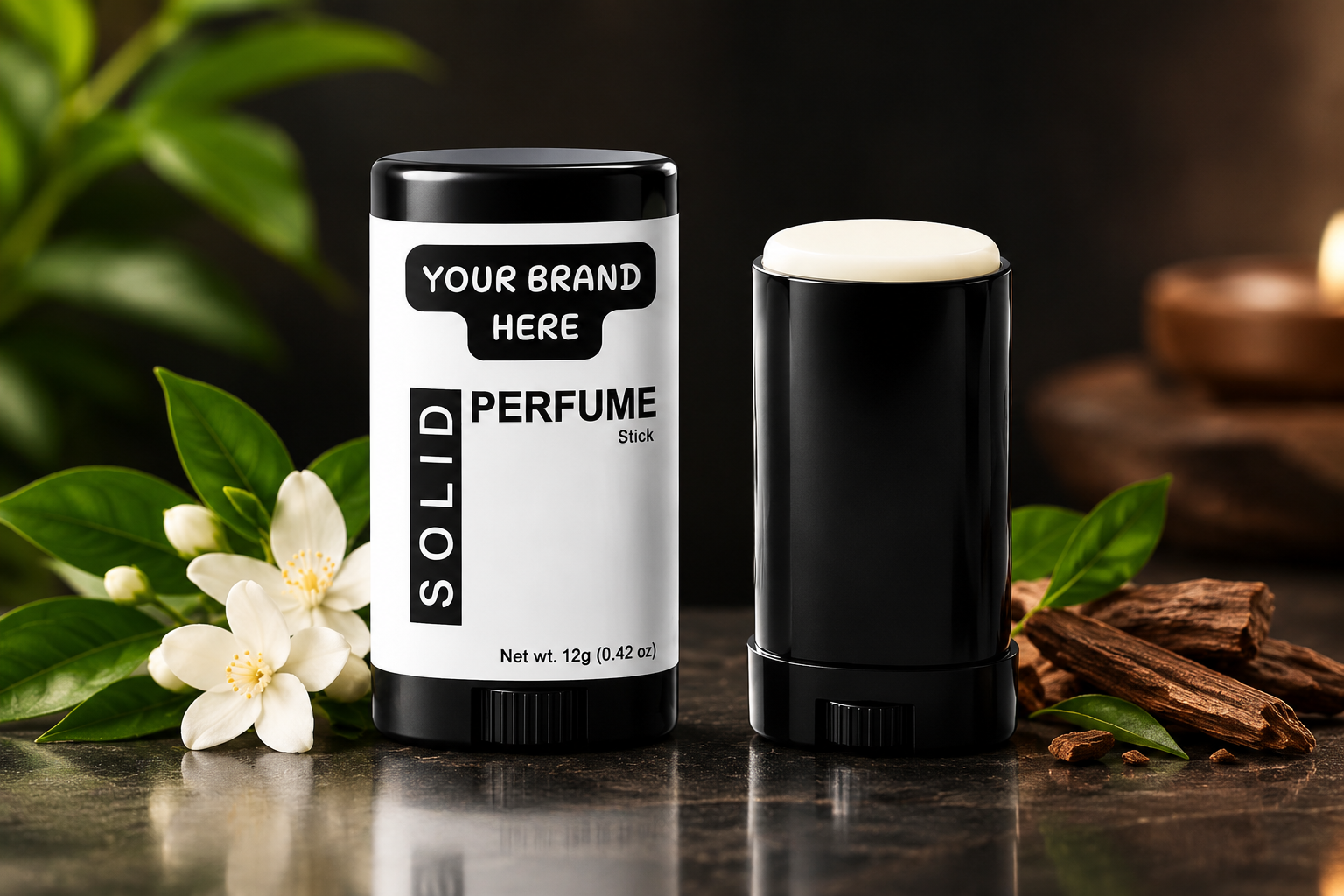
Solid perfume product concept for private label fragrance manufacturing, custom branding and business development.
Starting a fragrance business does not always mean investing in your own factory, production machinery and manufacturing infrastructure. Businesses can explore third-party and private label manufacturing to develop products through an experienced external manufacturing partner.
One product category worth exploring is solid perfume. Unlike conventional spray perfumes, solid perfumes are generally available in a compact balm or stick format. Their portable presentation offers brands another way to introduce fragrance products into their existing cosmetic, personal care or lifestyle collections.
For business owners, the opportunity goes beyond simply selecting a fragrance. You need to understand the formulation, product consistency, packaging compatibility, branding requirements, minimum order quantity and overall manufacturing cost before launching your product.
Whether you are an entrepreneur planning your first fragrance brand or an established company expanding its product portfolio, choosing the right private label solid perfume manufacturer can make the development and production process easier to manage.
Planning to start your own solid perfume brand? UNICO Pharmaceuticals has a dedicated solid perfume manufacturing page for businesses exploring this product category. Share your product concept, preferred fragrance, packaging requirements and estimated order quantity to discuss the manufacturing options available for your project.
1. What Is Private Label Solid Perfume Manufacturing?
Private label solid perfume manufacturing is a business arrangement in which a manufacturer produces a solid fragrance product for another business to sell under its own brand name. Instead of creating a production facility, the brand works with an external manufacturer to discuss the product, formulation, fragrance, packaging and manufacturing requirements.
Solid perfume is generally a fragrance product with a balm-like or semi-solid consistency. It is commonly packed in a compact stick or container and applied directly according to its product instructions. This makes it a different product format from traditional liquid spray perfumes.
In a private label arrangement, the business develops its brand identity while the manufacturing partner handles the agreed production responsibilities. Depending on the supplier's capabilities and the project agreement, the process may involve:
- Selection of an available solid perfume formulation.
- Discussion of fragrance preferences and product requirements.
- Evaluation of product samples, where available.
- Selection of suitable containers and packaging.
- Brand name, label artwork and product presentation.
- Bulk manufacturing according to approved specifications.
- Relevant quality checks and product documentation.
How does private label solid perfume work?
Imagine you operate a skincare company and want to introduce a fragrance product alongside your existing range. Setting up a separate perfume manufacturing facility may not be practical for your business. Instead, you can approach a solid perfume manufacturer, discuss your product idea, review available options and finalise a suitable manufacturing arrangement.
The finished product can then be marketed under your own brand identity, subject to the agreed branding, ownership, labelling and regulatory requirements.
Who should consider solid perfume contract manufacturing?
- New entrepreneurs: People planning to establish their own fragrance or personal care brand.
- Cosmetic companies: Businesses looking to expand beyond skincare and haircare products.
- Retailers: Companies interested in introducing their own branded fragrance products.
- Distributors and wholesalers: Businesses exploring branded products for their sales network.
- E-commerce brands: Online businesses interested in adding compact fragrance products to their catalogue.
- Established businesses: Companies planning to introduce another product category for their customers.
If you are planning to manufacture solid perfume under your own brand, explore the dedicated solid perfume manufacturers and manufacturing solutions page of UNICO Pharmaceuticals.
2. Why Is Solid Perfume a Product Opportunity for Brands?
The fragrance category includes different product formats designed around consumer preferences and usage habits. Solid perfume is one such format that businesses can consider when planning a new fragrance product or expanding an existing personal care collection.
Its compact presentation, direct application method and packaging possibilities make it an interesting category for brands that want to explore something different from conventional spray perfumes.
Compact and convenient product format
Solid perfume sticks and compact containers can be designed for convenient storage in handbags, travel kits, office drawers and personal care pouches. This format may appeal to consumers who prefer carrying a small fragrance product instead of a conventional perfume bottle.
Different application experience
Solid perfume is generally applied directly to the intended skin area rather than sprayed into the surrounding air. Businesses can communicate this application format clearly through product packaging, website descriptions and usage instructions.
Opportunities for attractive packaging
Packaging is an important part of a fragrance product's identity. A solid perfume container can be presented with distinctive colours, brand artwork, product naming and outer packaging. The right presentation can help a business create a consistent identity across its product range.
Suitable for different business categories
Solid perfume can be explored by cosmetic brands, personal care companies, gifting businesses, online retailers and fragrance-focused entrepreneurs. Each business can evaluate the product according to its own target audience, distribution model and price positioning.
Potential to develop multiple fragrance variants
Brands may consider creating a collection with different fragrance profiles instead of relying on a single product. For example, a range could include fresh, floral, woody or warm fragrance directions, depending on available formulation and fragrance options.
However, product performance should always be evaluated on the basis of the actual formulation. Solid perfume should not automatically be advertised as longer-lasting, safer or more sustainable than every liquid perfume.
3. Benefits of Private Label Solid Perfume Manufacturing for Businesses
For a business entering the fragrance market, manufacturing is only one part of the overall investment. Branding, product development, packaging, inventory, marketing and distribution also require attention.
Working with a suitable private label manufacturer can help businesses organise these requirements without independently establishing a complete production facility.
1. Launch your own fragrance brand
One of the main reasons businesses explore private label manufacturing is the opportunity to introduce products under their own brand name. You can develop your brand identity through product naming, logo placement, packaging artwork and consistent visual presentation.
This is particularly useful for businesses that already have an established customer base and want to introduce a new product category.
2. Focus on business growth instead of factory setup
Setting up a manufacturing facility requires investment in equipment, infrastructure, trained personnel, raw materials and quality systems. An external manufacturing arrangement can provide another route to production, allowing the business to focus more on sales, marketing, distribution and customer relationships.
3. Explore fragrance and packaging options
The product can be planned around the brand's intended market. Depending on the manufacturer's capabilities, businesses may discuss fragrance selection, available formulations, packaging styles and label customisation.
Before confirming an order, make sure the selected fragrance, formulation and packaging are technically suitable and commercially practical.
4. Expand your existing cosmetic product range
If you already sell skincare, haircare or personal care products, solid perfume may provide an additional category to explore. A carefully planned product range can help your brand serve customers interested in multiple personal care products.
5. Plan production according to demand
Businesses can discuss their expected order quantities with the manufacturer and understand the applicable minimum order requirements. Proper inventory planning helps avoid committing more working capital than the business can comfortably manage.
6. Build your own sales and distribution network
When manufacturing is handled through an external partner, the business can devote more attention to developing its sales channels. These may include an independent website, online marketplaces, retail outlets, wholesale distributors or business-to-business relationships.
Important for new brand owners: Before placing a bulk order, ask for complete details about product specifications, MOQ, unit pricing, packaging, sampling, quality checks, payment terms and production timelines. A clear agreement helps avoid confusion during manufacturing.
4. How Does Solid Perfume Manufacturing Work?
If you are approaching a solid perfume manufacturer for the first time, understanding the manufacturing process will help you prepare a better product brief. It also makes it easier to discuss your requirements and evaluate the quotation.
Although the exact process varies between manufacturers, a typical private label project can be divided into the following stages.
Step 1: Decide what type of solid perfume you want to launch
Start by defining your product concept. Think about the customers you want to target, the fragrance style you prefer, the packaging format and the price range in which you want to position the product.
For example, a premium fragrance brand may have different packaging and presentation requirements from a business developing affordable everyday personal care products.
Step 2: Share your product requirements with the manufacturer
Prepare a short product brief containing the important details of your project. You do not need a complicated technical document for the first discussion. Start with the basic information:
- Your company or proposed brand name.
- Required product: solid perfume or solid perfume stick.
- Preferred fragrance profile.
- Approximate product quantity or order requirement.
- Preferred packaging format.
- Target selling market.
- Any specific formulation or ingredient requirements.
Providing this information helps the manufacturer understand your requirements and assess which options may be suitable.
Step 3: Discuss formulation and fragrance selection
The next step is to understand the available formulation options and fragrance possibilities. Discuss the desired consistency, application experience and fragrance character. If you require a custom fragrance or formulation, ask about development feasibility, sampling and any additional charges.
Step 4: Evaluate the product sample
If samples are available, evaluate them before approving bulk production. Check the consistency, ease of application, fragrance character, appearance and overall product experience.
Share clear feedback with the manufacturer and make sure the final approved product specifications are documented.
Step 5: Finalise packaging and brand artwork
Choose the appropriate container and prepare the brand artwork. Check the logo, product name, label dimensions, ingredient information and required declarations.
If you want an outer carton or additional packaging, discuss its availability and cost before finalising the order.
Step 6: Confirm pricing, MOQ and manufacturing terms
Before production begins, confirm the order quantity, final product specifications, unit price, packaging charges, payment schedule and expected production timeline.
Make sure both parties understand which services and materials are included in the quotation.
Step 7: Manufacturing and quality checks
The product is manufactured according to the approved specifications and the applicable production procedures. Relevant quality checks may include raw material verification, appearance, consistency, packaging compatibility and finished product testing, depending on the formulation and requirements.
Step 8: Final product review and dispatch
Once production is completed, confirm the agreed product quantity, packaging, labelling and required documentation. Discuss dispatch arrangements, transportation and storage requirements with the manufacturer.
| Manufacturing Stage | What You Need to Finalise |
|---|---|
| Product planning | Target audience, product concept and price positioning |
| Formulation | Base, consistency and fragrance preferences |
| Sampling | Product evaluation and approval |
| Packaging | Container, branding and label artwork |
| Commercial planning | MOQ, quotation and payment terms |
| Production | Approved specifications and quality checks |
| Dispatch | Final quantity, documentation and delivery |
Planning a Solid Perfume Manufacturing Project?
You can start by sharing your product idea, preferred fragrance and estimated order quantity. Having these details ready helps make the initial manufacturing discussion more productive.
Explore Solid Perfume Manufacturing →5. Solid Perfume Formulation and Fragrance Selection
Formulation is one of the most important parts of solid perfume product development. It determines how the product looks, feels and performs during application and storage.
Unlike a conventional liquid perfume, a solid perfume requires a suitable base that can hold the fragrance while maintaining the intended solid or semi-solid consistency.
Understanding solid perfume ingredients
Depending on the formulation, solid perfumes may contain ingredients such as:
- Waxes: Used to help provide structure and firmness.
- Oils and emollients: May contribute to the product's texture and application feel.
- Fragrance materials: Provide the intended scent profile.
- Other formulation ingredients: May be included to support the required product characteristics and stability.
The actual ingredient list depends on the selected formulation. Businesses should request the relevant product specifications and ingredient information before approving a product.
Why is product consistency important?
A solid perfume should have a consistency suitable for its intended packaging and application method. A formula that is too firm may be difficult to apply, while an overly soft product may create problems during storage or transportation.
The manufacturer should evaluate the formulation according to the intended product format and relevant storage conditions.
How to select the right fragrance for your brand
Fragrance selection should be based on your target customer and brand positioning. Some possible fragrance directions include:
- Fresh fragrances: For brands exploring clean and refreshing scent profiles.
- Floral fragrances: For products built around floral scent characteristics.
- Woody fragrances: For brands interested in warm and woody fragrance directions.
- Citrus fragrances: For fresh, bright and citrus-inspired product concepts.
- Warm fragrances: For products with deeper and warmer scent profiles.
These are general fragrance categories. The actual options available depend on the manufacturer's fragrance range and formulation compatibility.
Check fragrance compatibility and stability
A fragrance that smells suitable on its own may not behave exactly the same way after being incorporated into a solid perfume base. The formulation should be evaluated for fragrance compatibility, consistency, odour changes, packaging interaction and stability under relevant conditions.
Discuss specific ingredient requirements
If your brand has particular ingredient preferences or restrictions, communicate them before formulation approval. Do not assume that a requested ingredient exclusion or natural formulation is automatically available. Ask the manufacturer to confirm feasibility and the corresponding product specifications.
Brand owner tip: Do not select a fragrance only because it is popular. Consider your target audience, product positioning, packaging, price range and the overall identity you want customers to associate with your brand.
6. Custom Packaging and Private Label Branding for Solid Perfume
A good product needs packaging that represents the brand and suits the actual formulation. In the fragrance market, packaging is often one of the first things customers notice, making it an important part of product development.
For private label solid perfume, the container must be practical, easy to use and compatible with the product's consistency.
Choose the right solid perfume container
Depending on the available packaging range, businesses may explore different container formats such as:
- Twist-up solid perfume sticks.
- Compact solid perfume containers.
- Small portable balm-style packaging.
- Other suitable packaging formats offered by the manufacturer.
The right choice depends on the product quantity, dispensing mechanism, customer preferences and packaging budget. Always confirm the availability of the required format with the manufacturer.
Create packaging that reflects your brand
Your product packaging should communicate the brand identity clearly. Consider the following elements:
- Brand logo and product name.
- Fragrance variant name.
- Container colour and overall appearance.
- Readable label design.
- Required product and ingredient information.
- Suitable outer packaging, where applicable.
Why packaging compatibility matters
Packaging is not only about appearance. The selected container should work properly with the finished formulation. Check the closure, dispensing mechanism, material compatibility, label adhesion and product storage requirements.
Before placing a bulk order, request confirmation of the proposed packaging specifications and evaluate a sample where possible.
Plan packaging costs before production
Custom artwork, printed containers, labels and outer cartons can affect the total project cost. Discuss these requirements at the beginning so that the quotation reflects the actual packaging you intend to use.
If you are also planning to develop other personal care products under your brand, explore the cosmetic manufacturing solutions offered by UNICO Pharmaceuticals.
7. How to Choose a Solid Perfume Manufacturer in India
Finding the right solid perfume manufacturer in India is an important step for any business planning to launch its own fragrance brand. The manufacturer you select will influence the production process, product specifications, packaging decisions, communication and overall project execution.
Instead of choosing a supplier only because of a low quotation, evaluate whether the manufacturer can support your actual product requirements.
1. Check relevant product manufacturing capabilities
First, confirm whether the manufacturer can produce the solid perfume format you want. Discuss the available formulation options, fragrance selection, product development process and production requirements.
Ask which activities are handled directly by the manufacturer and whether any part of the project depends on external suppliers.
2. Understand the formulation and sampling process
A professional manufacturing discussion should cover the product formulation, sample evaluation and approval process. Ask how changes to the fragrance, consistency or packaging will be managed before bulk production.
3. Review quality control procedures
Product quality should be evaluated through relevant manufacturing procedures and documented specifications. Ask about raw material checks, batch records, finished product inspection and applicable testing arrangements.
4. Ask about MOQ and bulk manufacturing capacity
The minimum order quantity can differ depending on the product, formulation, packaging and customisation requirements. Make sure you understand the MOQ for each fragrance or variant before planning your initial inventory.
5. Evaluate packaging and branding support
Ask which container types, label options and outer packaging formats are available. If you already have your own artwork, confirm the required file format and packaging dimensions before printing.
6. Compare the complete quotation
Compare suppliers on equivalent specifications. A manufacturing quotation should clearly explain the product, quantity, unit cost, packaging, applicable development charges, testing, taxes and delivery terms.
7. Verify relevant company information and documentation
Review the company's background and request relevant documentation before finalising your order. Where certificates are provided, verify the issuing organisation, validity, facility and applicable scope.
You can review the UNICO Pharmaceuticals company profile and its certificate information as part of your supplier evaluation.
8. Check communication and project transparency
Clear communication is essential when developing a new product. Your manufacturing partner should be able to explain the requirements, approvals, costs and production schedule. Make sure important specifications and commercial terms are documented.
Checklist Before Selecting a Solid Perfume Manufacturer
- Relevant solid perfume manufacturing capabilities.
- Available fragrance and formulation options.
- Clear sampling and product approval process.
- Suitable packaging and branding arrangements.
- Transparent MOQ and manufacturing quotation.
- Relevant quality procedures and documentation.
- Clearly defined production and delivery terms.
- Understanding of applicable regulatory responsibilities.
8. Private Label vs Third-Party Solid Perfume Manufacturing
When searching for a solid perfume manufacturer, you may come across the terms private label manufacturing and third-party manufacturing. These terms are closely related, and some suppliers use them to describe overlapping services.
In general, private label focuses on selling products under your own brand identity, while third-party manufacturing describes production carried out by an external manufacturing company. The actual scope depends on the supplier and the agreement.
| Comparison Factor | Private Label Manufacturing | Third-Party Manufacturing |
|---|---|---|
| Branding | Product is marketed under the buyer's brand. | Product may be manufactured for the buyer's brand. |
| Formulation | May involve available or agreed customised formulations. | May involve existing or separately developed formulations. |
| Packaging | Branding and packaging options depend on the supplier. | Packaging responsibilities are agreed between both parties. |
| Product customisation | Depends on available customisation services. | Depends on the manufacturer's technical capabilities. |
| Production quantity | Subject to the applicable MOQ. | Subject to capacity and agreed order quantity. |
| Suitable for | Businesses building their own branded product range. | Businesses outsourcing product manufacturing. |
Both arrangements can help businesses work with an external manufacturer instead of setting up their own production infrastructure. The right option depends on your product requirements, the services offered, commercial terms and ownership arrangements.
If you want to discuss a private label or third-party solid perfume project, visit the UNICO solid perfume manufacturing page for further information.
9. Solid Perfume Manufacturing Cost and MOQ in India
One of the first questions business owners ask when planning a new fragrance product is: How much does solid perfume manufacturing cost?
The answer depends on the formulation, fragrance, packaging, order quantity, development requirements and other project-specific factors. There is no single manufacturing price that applies to every solid perfume product.
What factors affect solid perfume manufacturing cost?
- Product formulation: The ingredients, technical specifications and formulation requirements.
- Fragrance selection: The selected fragrance materials and any custom development work.
- Packaging type: Container material, design, size, decoration and outer packaging.
- Order quantity: The number of units required and the manufacturer's pricing structure.
- Sampling and development: Applicable sample preparation or formulation charges.
- Quality requirements: Relevant testing and product verification requirements.
- Printing and branding: Artwork preparation, labels and packaging decoration.
- Logistics: Transportation, taxes and other applicable expenses.
What is MOQ in solid perfume manufacturing?
MOQ stands for Minimum Order Quantity. It is the minimum quantity a manufacturer requires for a particular production order.
The MOQ may vary depending on the formulation, packaging format, fragrance selection and production requirements. If you want to launch multiple fragrance variants, ask whether a separate MOQ applies to each variant.
How should a new brand plan its first manufacturing order?
If you are launching your first product, avoid deciding the order quantity only on the basis of a lower unit price. Think about your expected sales, available budget, marketing plan, inventory storage and distribution capacity.
For example, a business selling through its own website may have different stock requirements from a distributor supplying multiple retail outlets.
The objective should be to select an order quantity that matches your commercial plan and confirmed manufacturing requirements.
What should you ask before requesting a quotation?
- What is the MOQ for the selected solid perfume product?
- What formulation and fragrance options are available?
- What packaging formats can be considered?
- Is sample evaluation available?
- What is included in the quoted unit price?
- Are there separate artwork or packaging charges?
- What is the expected production timeline?
- Which quality documents and product specifications are available?
Get a project-specific quotation: Share your required product, preferred fragrance, packaging concept and estimated order quantity with UNICO Pharmaceuticals. This information can help the team understand your requirement and discuss applicable manufacturing options.
10. How to Launch and Market Your Own Solid Perfume Brand
Getting a product manufactured is an important milestone, but it is not the end of the process. A successful product launch also requires clear positioning, attractive product presentation, suitable pricing and a well-planned sales strategy.
Before starting production, think about how your product will reach its customers and what will make your brand recognisable in the market.
Define your target market
Identify the customers you want to serve. Are you planning to sell to everyday fragrance users, gift buyers, premium personal care customers or a specific retail audience?
Understanding your target market helps you make better decisions about fragrance, packaging, product quantity and price positioning.
Develop a clear brand identity
Choose a suitable brand name, logo, colour combination and product presentation. Your solid perfume packaging should look consistent with the rest of your brand, particularly if you already sell other cosmetic or personal care products.
Create a professional product page
Your website should provide clear product information, including:
- Product name and fragrance variant.
- Net quantity and packaging format.
- Ingredient information.
- Application directions.
- Storage instructions.
- Product photographs.
- Price, delivery and customer support information.
Use SEO to attract relevant customers
Search engine optimisation can help your website reach people looking for solid perfume products and fragrance-related information. Use relevant keywords naturally in product descriptions, page titles, headings and supporting content.
If you operate a manufacturing business, build dedicated pages for relevant B2B search terms such as private label solid perfume manufacturer, solid perfume manufacturing and solid perfume manufacturers in India. Your manufacturing page should explain the services available and provide a clear way to submit an enquiry.
Use product photography and packaging visuals
Good product images help customers understand the product before purchasing. Show the actual container, packaging, texture and branding clearly. Ensure the images accurately represent the finished product.
Explore different sales channels
Depending on your business model, you may consider:
- Your own e-commerce website.
- Online marketplaces.
- Retail and cosmetic stores.
- Wholesale and distribution networks.
- Corporate gifting and business relationships.
Track customer response
Monitor website visits, enquiries, customer feedback, product sales and repeat purchases. These details can help you understand which fragrance variants and product presentations are receiving better responses.
For B2B manufacturing companies, the most important metric is not simply website traffic. Qualified enquiries from businesses genuinely interested in manufacturing are much more valuable.
11. Solid Perfume Manufacturing with UNICO Pharmaceuticals
Choosing the right manufacturing partner is an important part of developing your own fragrance brand. You need a company that can understand your product concept, explain the available manufacturing options and provide clarity about the requirements involved in taking the project forward.
UNICO Pharmaceuticals has more than 35 years of industry experience, as stated in its company information. Businesses exploring solid perfume manufacturing can use the company's dedicated product page to begin discussing their requirements.
Whether you are an entrepreneur planning a new brand, a cosmetic company expanding its range or a distributor exploring branded fragrance products, start by explaining what you want to manufacture and how you intend to position it in the market.
Discuss your solid perfume product requirements
Every manufacturing project is different. Before starting the discussion, consider the following:
- Are you planning to launch a new perfume brand or expand an existing one?
- Do you need a solid perfume stick or another suitable format?
- What type of fragrance profile are you interested in?
- Do you have any specific formulation preferences?
- What kind of packaging do you want for your product?
- What is your approximate bulk production requirement?
- Which market or customer segment are you targeting?
Sharing these details will help the manufacturing team understand your product idea and discuss relevant possibilities.
Explore UNICO's manufacturing information
You can explore the dedicated Solid Perfume Manufacturing page to learn more about the relevant product category.
You can also visit the About UNICO Pharmaceuticals page to understand the company background and explore its broader cosmetic manufacturing services.
Review relevant quality and company documentation
Before selecting any manufacturing partner, review the relevant company information and documentation. You can visit the UNICO certificates page and confirm the applicable documentation, scope and validity directly.
Get started with your manufacturing enquiry
You do not need to have every technical detail finalised before making an initial enquiry. Start with your brand idea, required product, fragrance preference and approximate order quantity.
The next discussion can help clarify available product options, customisation requirements, packaging possibilities, MOQ and the commercial details relevant to your project.
What Information Should You Share in Your Enquiry?
- Your company or brand name.
- Product you want to manufacture.
- Preferred fragrance or product concept.
- Packaging and branding requirements.
- Estimated order quantity.
- Your contact details and target market.
Providing these basic details makes it easier to understand your manufacturing requirement and take the discussion forward.
Submit Your Manufacturing Enquiry →12. Final Thoughts: Is Private Label Solid Perfume Right for Your Business?
Private label solid perfume manufacturing can be an interesting opportunity for businesses planning to enter the fragrance market or expand their existing cosmetic and personal care product range. It offers a way to develop products under your own brand identity while working with an external manufacturing partner.
However, launching a successful product requires more than selecting an attractive fragrance and packaging. You need to understand your target audience, evaluate the formulation, finalise suitable packaging, calculate the manufacturing cost and plan your initial inventory carefully.
Before placing a bulk order, compare manufacturers, review the available product options, evaluate samples where possible and confirm the MOQ, quotation, quality procedures and applicable documentation.
If you are planning to launch your own solid perfume brand, UNICO Pharmaceuticals provides a starting point for discussing your product and manufacturing requirements. Share your product idea and estimated production quantity to explore the options available for your project.
Ready to Launch Your Own Solid Perfume Brand?
Looking for a manufacturing partner for your private label solid perfume project? Discuss your fragrance preferences, product formulation, custom packaging and bulk manufacturing requirements with UNICO Pharmaceuticals. Share your business requirement to start the conversation.
Submit Your Manufacturing Enquiry →Frequently Asked Questions About Solid Perfume Manufacturing
Planning to start a fragrance brand? Here are answers to common questions about private label solid perfume, manufacturing, packaging, formulation, MOQ and bulk production.
1. What is private label solid perfume manufacturing?
Private label solid perfume manufacturing involves producing a solid fragrance product for a business to sell under its own brand name. Depending on the manufacturer's capabilities and agreement, the project may include formulation selection, fragrance options, packaging and branding.
2. Can I start my own solid perfume brand without a factory?
Yes. You can explore private label or third-party manufacturing instead of setting up your own production facility. A suitable manufacturer can produce the product according to agreed specifications while you focus on branding, marketing and distribution. Confirm the supplier's capabilities and commercial terms before starting.
3. How do I find a solid perfume manufacturer in India?
Start by researching manufacturers that offer relevant solid perfume production capabilities. Evaluate their formulation options, packaging support, sampling process, quality procedures, MOQ, pricing and documentation. You can also explore the UNICO solid perfume manufacturing page to discuss your requirements.
4. What is the difference between solid perfume and liquid perfume?
Solid perfume generally has a balm-like or semi-solid consistency and is applied directly according to its instructions. Liquid perfume is typically dispensed from a bottle using a spray or another applicator. Both formats differ in formulation, packaging and application method.
5. Can I manufacture solid perfume under my own brand name?
Yes, private label manufacturing arrangements are designed to allow products to be marketed under the buyer's brand name, subject to the agreement and applicable regulations. Discuss brand ownership, artwork, labelling and packaging responsibilities with the manufacturer.
6. Can I customise the fragrance of solid perfume?
Fragrance customisation depends on the manufacturer's available options and development capabilities. Ask whether you can select from existing fragrances or discuss a custom fragrance requirement. Also confirm sampling, development charges and applicable MOQ.
7. What ingredients are used in solid perfume?
Solid perfume formulations may contain waxes, oils, emollients, fragrance materials and other ingredients needed to achieve the required texture and stability. The exact formulation varies between products. Request the ingredient information and product specifications from the manufacturer.
8. What packaging options are available for solid perfume?
Depending on the available packaging range, businesses may explore twist-up sticks, compact containers, labels and outer cartons. The selected packaging should be suitable for the product formulation and application method. Confirm available options with the manufacturer.
9. What is the MOQ for private label solid perfume?
MOQ means Minimum Order Quantity. It varies according to the manufacturer, formulation, packaging, fragrance and production requirements. Contact the manufacturer with your product concept and estimated order quantity to confirm the applicable MOQ.
10. How much does solid perfume manufacturing cost in India?
The cost depends on the formulation, fragrance materials, packaging, quantity, sampling, testing and other project-specific requirements. Request a detailed quotation covering the unit price, additional charges, taxes and delivery terms.
11. How long does private label solid perfume manufacturing take?
The production timeline depends on formulation availability, sampling, packaging procurement, artwork approval and production scheduling. Ask the manufacturer for a project-specific timeline after sharing your requirements.
12. Can I launch multiple solid perfume fragrance variants?
Multiple fragrance variants may be possible depending on the manufacturer's capabilities and available options. Discuss each variant separately and confirm whether individual formulation, sampling, packaging and MOQ requirements apply.
13. What should I check before choosing a solid perfume manufacturer?
Evaluate relevant manufacturing capabilities, formulation options, sample approval, packaging, quality procedures, MOQ, quotation, lead time and documentation. Also confirm the responsibilities of both parties for product specifications and regulatory requirements.
14. What is the difference between private label and third-party manufacturing?
Private label generally describes marketing a product under your own brand, while third-party manufacturing refers to production by an external manufacturer. These services can overlap. The exact scope depends on the supplier's agreement and capabilities.
15. Does UNICO Pharmaceuticals offer solid perfume manufacturing?
UNICO Pharmaceuticals has a dedicated solid perfume manufacturing page. Contact the company to confirm current product options, manufacturing capabilities, packaging, customisation, MOQ and project requirements.
16. Can startups and new businesses enquire about solid perfume manufacturing?
Businesses planning to launch a new fragrance brand can enquire about available manufacturing options. Prepare your product concept, fragrance preference, packaging requirements and estimated order quantity before contacting the manufacturer.
17. How can I request a solid perfume manufacturing quotation from UNICO?
Visit the UNICO Pharmaceuticals contact page or its solid perfume manufacturing page. Share your product idea, preferred fragrance, packaging requirements and approximate order quantity so the team can understand your enquiry.
Explore Related UNICO Pharmaceuticals Manufacturing Pages
Explore more product categories and company information if you are planning to develop a wider cosmetic or personal care product range.
UNICO Pharmaceuticals Solid Perfume Manufacturers Cosmetic Manufacturing About UNICO Pharmaceuticals Certificates and Quality Information Skin & Hair Care Products Contact UsThis article provides general information about private label solid perfume and fragrance product manufacturing. Formulations, ingredients, fragrance options, packaging, manufacturing capabilities, minimum order quantities, pricing and production timelines vary by project and must be confirmed directly with the manufacturer. Product claims, testing and labelling should comply with applicable requirements in the intended market.